



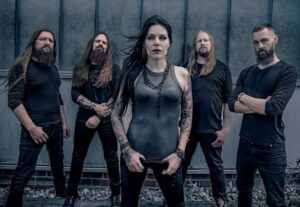
Britta Görtz of the band Hiraes has already built a career spanning well over 20 years. She’s what you might call a “busy bee,” and over the past year, in addition to her work with Hiraes, she’s also filled in for Heaven Shall Burn, collaborated with Kreator, and even performed a few shows with them. She also runs her own Harsh Vocal School. It’s time to catch up with Britta about the past, present, and future.
Hi Britta, first of all, thank you so much for taking the time to do this interview. I’d like to take a look with you at the past, the present, and the future. But first of all, how are you doing? 
Britta:Thanks for asking—I’m doing great. Things are actually going pretty well in every area. My Harsch Vocal School is growing and thriving. I’m on the road a lot with Hiraes. We’re working on our third album, so my metal heart has nothing to complain about.
– You’re incredibly busy and juggling a lot of things at once: Hiraes, vocal coaching, side projects, and collaborations. Do you still find time to catch your breath in between, or would you rather have 36 hours in a day?
Britta:Well, of course I chose this for myself, and it makes me chuckle every now and then. “Choose your misery” and all that, right? I think that even if my day were 36 hours long, I still wouldn’t have any more time to do nothing. But I really do love being busy and on the road, so I don’t actually find it that stressful. Of course, I always have to make sure I find time for friends, and I’m happy to take that time. It’s very important to me to maintain social connections outside of my music life, and sometimes time just flies by, you know? So weeks go by, and I’m like, “Whoa, where did the time go?” So the fact that it’s already almost the end of August is sometimes a little hard to believe—when I look at the calendar, of course it’s true, but I don’t want to complain about it. It’s all a lot of fun.
– Last year, shortly before your show with Hiraes at Rockhard Festival, you were asked if you could “quickly” step in as an emergency replacement for Heaven Shall Burn, since their singer, Marcus Bisschof, couldn’t—or wasn’t allowed to—perform due to a vocal injury, and a major tour was planned. Looking back, how was that experience, and did you notice that this collaboration opened up new opportunities for you?
Britta:So, of course, that whole experience last year was totally crazy, and when I look back now on everything that’s happened since then, I—and we as a band—are already noticing positive effects. Naturally, a lot more people have heard my name now, and a lot more people have seen me on stage. The demand for Hiraes as a band has risen steadily because the attention was, of course, very high there, and we’re happy to take that with us. We all work really hard in the band and are just happy that this extra attention has given us a bit of a better standing—it’s, it’s, it’s totally clear. People still come up to me—just like you’re doing now in this interview—and ask me about it; it really is something special. So, that was a very intense time, just an absolutely crazy, crazy experience overall, and definitely a huge highlight of my time in the metal scene.
Tränenpalast
 -In the meantime, you’ve also collaborated with Kreator, sharing vocal duties with Mille on the song “Tränenpalast.” Afterward, you joined them for numerous concerts on their tour to perform the song live with Kreator. How did this collaboration come about, and was going on tour with them part of the plan from the start?
Britta:Mhm, mhm. Yeah, so this collaboration just developed naturally. To be honest, that’s the best part about it. At some point, on my way back from a Hiraes show, I got an email from Jens Bogren. Jens Bogren is a producer and mastermind at Fascination Street Studios in Sweden. That’s where Kreator recorded their album. The band wasn’t even in the studio anymore, and Jens asked me if I’d be up for recording some backing vocals for a few of the songs on very short notice, because he felt something was still missing—and as I said, it was really last-minute; he needed it the next day or the day after that. So I stayed up late that night, finished it up, and we even managed to do a final run-through, and it all went great. For “Tränenpalast”, I was actually only scheduled to do backing vocals at first, but then Jens thought it was great, and Mille thought it was great too, and then Mille thought, “Hey, maybe we should just turn this into a duet”—it would be a perfect fit for this song—and Jens asked me, I said, “Sure,” and then things just kind of took off from there. It wasn’t actually planned as a single at all. The label heard the finished song as a duet and said, “This is totally awesome—let’s shoot a fourth video for it, release it on Halloween, and run with it a bit more,” and that’s how it all came about. And I think, on the way back from the video shoot, Mille said something like, “By the way, it’d be awesome if you jumped on stage with us—so whenever you have time, come on by.” And yeah, then there were these two weeks when I didn’t have any shows with Hiraes, so I said, “Here, I actually have time.” And then the idea turned into a plan, and we did it—it was totally, totally awesome, of course. That it turned out that way. It’s especially cool because it didn’t come through some management company or anything like that, but simply because two people with similar musical tastes collaborated. Super cool.
– Life on tour continues as usual with Hiraes, too, since they’ve also been playing a lot of live shows over the past year and a half. Have these collaborations with other bands opened new doors for Hiraes lately?
Britta:Yeah, sure, so like I said earlier, these collaborations have obviously opened new doors for Hiraes, if only because of the increased attention that’s been generated around us. You can’t deny that, of course. Nevertheless, we have to deliver good work, and guys, we’re not going to pat ourselves on the back just because I’ve been involved somewhere else. You have to look at it that way too, but sure, definitely more PR: Bigger collaborations naturally raise your profile in a way you might not otherwise have.
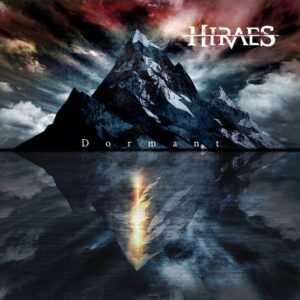
– Your latest album, “Dormant,” was released in 2024. Is the band already hard at work on new material, and if so, when can we expect a new album?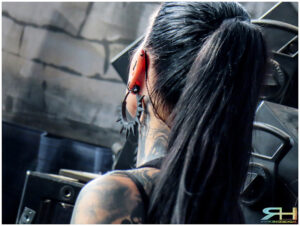
Britta:We’re working flat out on Album Number 3. We already have a few songs ready. There are a lot of demos, and this fall we’re going to really buckle down and get to work writing, recording, and planning the album. The release plan is already pretty much in place, but of course it always takes quite a while—even after the songs are finished—therefore we can’t actually pinpoint a release date, so we all still need a little patience, but yeah, we’re on it.
many “firsts”
-When you look back on your musical career, which has spanned more than 20 years, what would you describe as one of the greatest highlights? And where there are highlights, there are of course also low points—what would those be?
Britta:Well, I’d say that, from an outsider’s perspective, the biggest highlights are, of course, always the moments when you were really in the spotlight. For me personally, this whole wild journey has had so many highlights that I don’t even know where to start. I’ve been able to experience so many “firsts” with my bands—like the first Nightliner tour with Cripper, and with Overkill in 2010. I still remember when I opened the Nightliner door and was allowed to go inside—it was an incredibly great feeling, and I’d definitely count that as a highlight. And yeah, I could name so many things right now—of course, that time I filled in for Heaven Shall Burn last year is one of them. For me, that was a real summer fairy tale, an incredibly intense, mind-blowing experience, because I really felt my own strength and abilities there. That just felt so good, and being hit with all that incredible positivity from the metal scene was an absolute highlight. Founding my school—my Harsh Vocal School—is an absolute highlight for me, and maybe one that isn’t immediately obvious, but spending 20 years operating not quite in the professional sphere, but always somewhere between the underground and the big leagues, takes a lot of energy, a lot of money, and a lot of perseverance—and I consider it an absolute highlight that I get to experience this together with so many great people, whether in Cripper, Critical Mess, or Hiraes. It’s anything but a given that everyone puts so much effort into it, and that’s the kind of highlight that maybe doesn’t shine as brightly from the outside as it does from the inside.
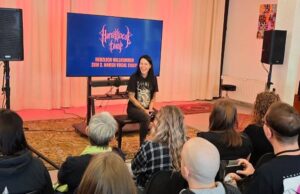
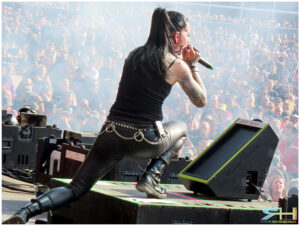 -Aside from your success with Hiraes, you’re also busy with Harsh Vocal Coaching, of course. Is that mainly limited to online sessions, or do you also plan regular in-person sessions with your students?
Britta:That’s right, my school is in Hanover. I’m from Hanover, and 95% of my classes are held online. I have students on four continents; I start at 8:30 a.m. and finish school at 6:15 p.m. So, they’re mainly online sessions.I’ve really specialized in that area.
Hmm, and not everyone can come to Hannover for in-person sessions.But that’s actually pretty good. I’d say that since the pandemic, this whole video thing has really taken off. So it’s going great. It starts at 8:30 a.m., and then people start yelling.
-You also recently helped Sabina Classen prepare for her performance with Temple of the Absurd. Was that mainly a social gathering, or did an experienced singer like Sabina actually benefit from this refresher course?
Britta:Sabina and I know each other, of course, and of course it was a friendly get-together, and of course I didn’t have to teach her how to sing, but she’s taken a two- or three-year break now, and Temple is, of course, quite different from Holy Moses—which means that vocally she’s in a similar range, but it still feels different to sing. Temple of The Absurd is slower-paced, has a completely different musical drive, and it just feels a little different to sing. So, just to get her back into the swing of things, I gave her a few vocal warm-up exercises, and we worked together on a couple of spots to give her a little more confidence. You just can’t forget—we’re all human. Even though Sabina has had an incredible career and a lot of experience, I think she hasn’t taken any breaks since she started. So to get back to that point—and especially with a band you haven’t been on stage with for so long— I think it’s just really cool to have a few people around you with whom you can just go over a few checkpoints, and it was a ton of fun—Sabina is just, she’s just awesome, and it was really great. Did she really benefit from this refresher course? Sure!
So, like I said, I wasn’t teaching her how to sing—I was just there by her side as a colleague, and I simply made things a little easier for her by sharing a few techniques she might not have known yet. She was definitely really happy about it, and as far as I know, the show went over very well.
harsh vocals
-What I’m really wondering is whether you ever sing without harsh vocals, what your voice sounds like then, and if there are any recordings of that. Or did you dive right into harsh vocals from the start and never let them go?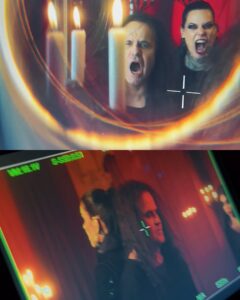
Britta:Yes, I sometimes sing with a clean voice, too. You can hear my clean vocals on both Hiraes releases. You can hear my clean vocals on several Gripper releases. You should check out the song “Undercurrent” from Hiraes—you’ll hear my clean vocals there, but I’m really into the harsh vocals. It’s kind of always been that way. I’m just crazy about them, so that’s what you’ll mostly hear from me in the future, too.
-Have you taken singing lessons, or are you self-taught?
Britta:Both. When I started out, there was no YouTube, nor were there any tutorials or anything like that for hair vocals. So my only option was to take singing lessons and join a choir—which I eventually got kicked out of. But the basics of vocal economy, breathing, vocal control, and so on—those don’t differ between clean vocals and harsh vocals.
So when it came to harsh vocals, my only option was to be self-taught.
Of course, I talked to a lot of colleagues back then—mostly guys, with just a few women. And then you just kind of muddle your way through. And actually, it’s not really a problem. Most singers out there are self-taught, especially when it comes to harsh vocals. But it’s worth something that a coach might save you a few extra rounds of trial and error—so it’s also a time-saver. If you’re somehow stuck at a certain point, it might be that—if you’re on your own—you’ll mull it over for a year, whereas a coach with a lot of experience might be able to say, “Hey, take a look over there; you can work on that a bit more, and then you’ll be able to overcome that hurdle in your voice.” So I think that’s the main point of it all.
-Do you prefer performing yourself, or do you get just as much joy and passion from coaching? Or when one of your students gives a great performance?
Britta:First and foremost, I see myself as a musician, and then as a coach. I love teaching—otherwise, I wouldn’t do it so much, of course. But it’s something completely different to be on stage with your own creative work and to share that with others. So I’d say that, for me, the passion for being a musician on stage is something special. It’s a fire that I believe will never go out. And then, when I pass that on and see my students on stage, my heart naturally swells with joy. So you can’t really compare the two. But of course, there’s nothing quite like the experience of being on stage yourself and sharing that moment with fans and other people. Nothing beats that.
exposure to metal
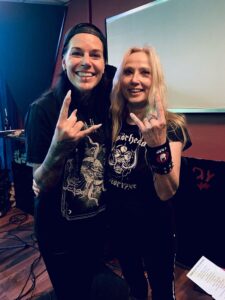 -When did you fall in love with the hard and heavy music genres, and what was the moment when you thought, “I want to do that too, and I’m going to play in bands”?
Britta:I have a brother who’s just under ten years older than me, and he’s the one who introduced me to bands like Iron Maiden, AC/DC, and Metallica—and I went to my first concerts with him, too. I still remember how we used to watch Guns N’ Roses together and stuff like that. And yeah, that’s definitely how I first got into the genre, and then, of course, I developed my own style as I grew up. There was a lot of crossover back then, a lot of grunge, and later on, metal and so on. So I’d say my first exposure to metal was probably when I was five or six years old—I just didn’t really notice it at the time. But I thought everything my brother thought was cool was cool, too, which is why I thought Iron Maiden and Eddie were especially—really, really—cool. The moment when I thought, “I want to do that too,” actually came relatively late. I mean, I’d always wanted to sing, but people told me, “You can’t do that—just forget it.” It’s total nonsense, really—as if you could just pick up an instrument and play it right away. But anyway, I tried my hand at a few other things. I played bass for a bit, then drums for a bit, but nothing really stuck. And it wasn’t until I discovered my harsh stuf that things really took off—and I’d say that was around 2003 or 2004. That’s when I thought, “Wow, somehow… I can actually do something with my voice. I’ve got to make this work somehow.”
-What bands are you listening to right now to unwind or find inspiration?
Britta:I have to be completely honest and say that when I’ve had a long day of coaching, I hardly listen to any music afterward. I spend the whole day immersed in my students’ music. We also do a lot of covers, and I’m surrounded by loud music all day long. Sometimes by the evening I’m pretty fed up with it and just need some peace and quiet—or maybe a podcast or something like that. When I do take the time to listen to music, it varies a lot; I can’t really pinpoint a specific style. I really like listening to Fit For An Autopsy, I really like Gojira, and I also listen to pop music. I really love Billie Eilish and enjoy listening to her a lot. Lately, I’ve also been going through a phase where I listen to a lot of David Bowie. Yeah, I think those are the kinds of things that are on heavy rotation for me.
-The first bands for Wacken 2027 have been announced, and Hiraes is on the list as well. Heaven Shall Burn is also on the lineup—can we expect a little collaboration, or is that chapter finally closed?
Britta:Yeah, we’re obviously super excited to be playing at Wacken next year. It was really cute, too. A friend of mine recorded a video of the bands being announced at Wacken, and when Hiraes popped up on the screen, there were some cheers. That was really cute and made me really happy. Yeah, Heaven Shall Burn is playing too. We’ll just have to see what happens there. You never know—if we’re playing on the same day, we might have to leave earlier or stay longer if we’re playing at another festival. We’ll see how it goes. But Heaven Shall Burn and I—we’re very close friends, with a strong bond. Whenever a good opportunity comes up, it could definitely happen. But for now, we just want to wait and see what the next few days bring and how everything plays out.
-What musical surprises can we expect from Britta Görtz in the near future? Are there any plans in the works? 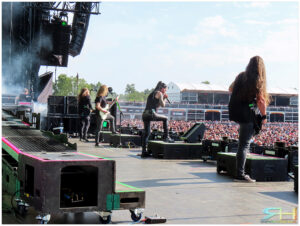
Britta:What kind of musical surprises? I don’t think you can expect any surprises from me right now. I’m completely focused on working with Hiraes on our third album and all the buzz that’s going to surround it. I’m also really happy to be able to focus entirely on my own project again.
huge passion
-And now the question we always ask our interviewees: What career would you have pursued if you hadn’t ended up in music?
Britta:It’s a little hard to say. I did have a career before I ended up in music. But I’d like to say that I would have become an astrophysicist. That’s definitely a pretty obvious choice, because the subject fascinates me and I just can’t get it out of my head. It’s a huge passion of mine to really dive into it as deeply as possible. And that’s just amazing. I would have been an astrophysicist.
-Thank you very much for taking the time to do this interview. Is there anything else you’d like to share with our readers?
Britta:Raymond, thank you so much for this interview. I’d like to say hi to all the Metalheads in the Netherlands. Go to concerts, support your small clubs, go to small shows just as much as you go to big ones. Back and support your bands. It’s becoming more and more important—and more and more difficult, especially for small bands—to tour and play gigs. So check out the merch, buy a T-shirt—but you all know the drill: metal!!
Interview by Raymond Helebrand – Images by Britta Görtz’s facebook and live Graspop by Raymond Helebrand